
I started writing this book because I had spent a career watching people mistake the appearance of certainty for leadership. In shipping, that gets people killed. In business, it gets companies destroyed. The truth — the one I learned on the bridge of a merchant ship long before I learned it in a boardroom — is that the most important navigation happens in conditions of genuine uncertainty, and the leaders who perform in those conditions are the ones who have stopped waiting for the map to appear.
That is what this book is about. And it is also about everything that costs you along the way.
Defining the Book
What No Map, Just Vision Actually Is
No Map, Just Vision is an Amazon #1 bestselling leadership memoir, published in August 2025, with ISBN 9349532646. It is available on Amazon worldwide — both Amazon.in and Amazon.com — and as a Kindle edition.
It traces my journey from a boy from Unnao, Uttar Pradesh, through maritime training at T.S. Chanakya, to becoming one of the youngest merchant ship captains of my generation, to founding Aethon Group in 2010 and Karma Developers in 2013 — and everything that was difficult, and costly, and uncertain about every step of that.
“There are memoirs that recount success. And then there are those that redefine it. No Map, Just Vision is not a tale of riches — it’s a blueprint for impact… This isn’t a business book. Nor is it a maritime memoir. It’s a manifesto for those who dare to lead without a map.”
— Khaleej Times, September 2025
The book has also received the Independent Press Award (New York) Distinguished Favorite designation — an independent literary recognition that evaluates books across categories including memoir and leadership writing.

What Khaleej Times said: “Singh speaks candidly about the solitude of command, whether on deck or in the boardroom, and the quiet strength required to build something that lasts. The prose is clean, deliberate, and often poetic. There’s no excess, no self-congratulation. Just clarity.”
The Five Core Themes of the Book
No Map, Just Vision covers a great deal of ground. But five themes run through it consistently — each one rooted in lived experience rather than theory.
Leading Under Uncertainty
The central argument of the book: that real leadership is not the ability to predict outcomes, but the discipline to act well without that certainty. This is something maritime command forces you to develop, and the book examines how it transfers to entrepreneurship.
The Loneliness of Command
One of the book’s most honest passages. Captain Singh writes candidly about the isolation that comes with senior leadership — at sea and in business — and the quiet strength required to function effectively within it. This is what Khaleej Times described as “the unseen pressures behind success.”
Entrepreneurship Without Inheritance
The book’s subtitle could have been “built without a head start.” Captain Singh was not born into wealth or connections. The book documents what it actually takes to build something of scale — and the decisions, failures, and recalibrations that the polished version of any success story leaves out.
The Maritime Philosophy of Leadership
Throughout the book, specific frameworks from maritime command — the midnight watch, voyage planning, crew resource management — are unpacked for their business equivalents. The book makes the case that the ocean is the world’s most demanding MBA, and that its graduates carry something business schools cannot replicate.
Building for Legacy, Not Applause
The final and perhaps most important theme. The book concludes not with a celebration of what Captain Singh has accumulated, but with a question — what do you leave behind? It is this theme that gives the title its full meaning: without a map, the only orientation is the vision of what endures.
“The ocean doesn’t wait for your fear to subside.”
— No Map, Just Vision, Captain (Dr.) Pradeep Singh
What Readers Take Away
The 5 Leadership Lessons That Stay With Readers
Khaleej Times noted that the book’s lessons “stay with you long after the last page.” These are the five that readers consistently identify as the most durable:
- Vision is not about seeing the future — it is about believing in it before anyone else does
This is the book’s core thesis, stated directly and returned to throughout. It reframes what “vision” means in a leadership context — not foresight, but conviction. The ability to commit to a direction in the absence of certainty is what separates leaders who build something from leaders who wait for conditions to improve. - Decisions under pressure must be made on the best available information — not perfect information
One of the most practically useful lessons in the book. Drawing from years of command at sea, where waiting for certainty is not an option, the book builds a clear framework for decision-making in ambiguous conditions — the exact environment that every founder and senior leader operates in. - Leadership isn’t inherited — it is earned in silence, in storms, and in the moments no one sees
One of the most cited lines from the book. It pushes back against the prevailing culture of performed leadership — the LinkedIn posts and the curated narratives — and makes the case that the real work happens invisibly, often in conditions of failure or doubt, and that this is where character is actually formed. - Success is not what you take — it is what you leave
The book’s most quoted line, and its philosophical conclusion. Captain Singh applies this not just to philanthropy or charity, but to how every business decision should be evaluated: does this create value that outlasts me? This is the operating principle behind Karma Developers’ development philosophy and the founding logic of Aethon Group. - Failure is not a footnote — it is a turning point
The book includes explicit accounts of failure — a property deal gone wrong in the UK, a chartering crisis that threatened to collapse the business. These are presented not as evidence of weakness but as the actual mechanism of growth. The book’s tone, as Khaleej Times noted, “is reflective, never preachy. Singh doesn’t romanticise hardship — he dissects it.”
What Sets It Apart
What Makes It Different from Other Leadership Books
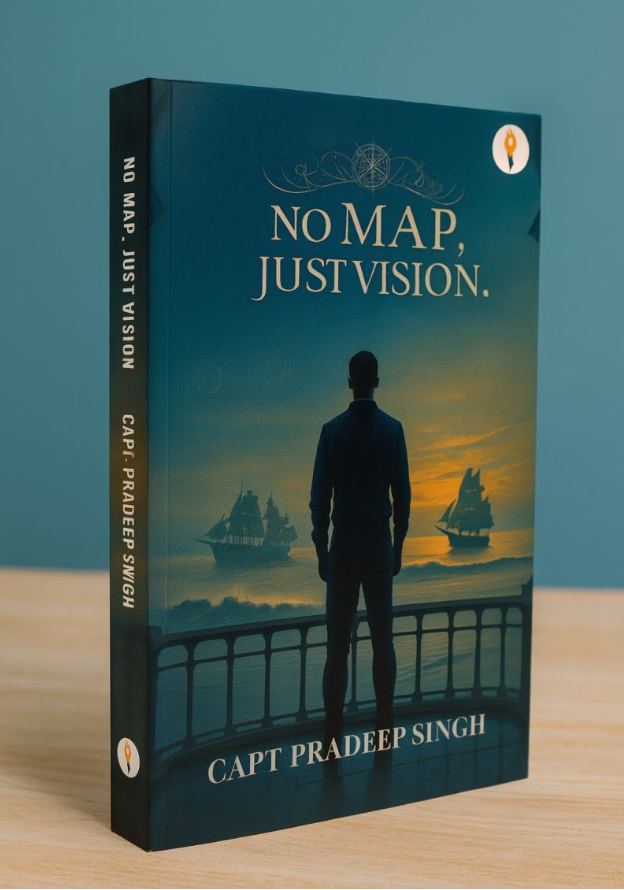
Most leadership books are built one of three ways: they are written by consultants who advise leaders, by academics who study leadership, or by celebrities who benefited from structural advantages they do not fully acknowledge. No Map, Just Vision is built differently.
The author commanded a merchant ship. Not as a metaphor for leadership. Literally. He was responsible for the lives of a multinational crew, a vessel worth tens of millions, and a cargo bound for markets on the other side of the world — and he made that responsibility work, in conditions of genuine uncertainty, for three decades. The leadership frameworks in this book come from that experience — not from research, and not from observing other people navigate it.
What also separates No Map, Just Vision is its specificity about failure. A failed property deal in the UK. A chartering crisis. These are named, described, and analysed — not softened into “challenges I overcame” or converted into lessons with tidy outcomes. The book treats difficulty as material to work with, not image to manage.
And finally: it asks something of the reader. The book is not only Captain Singh’s story. It ends as a challenge — to young professionals, to entrepreneurs, to anyone who has settled for a conventional definition of success. That challenge is what Khaleej Times described as a “call to action,” and it is what gives the book a durability that most leadership memoirs lack.
The Right Reader
Who Should Read No Map, Just Vision
- Maritime professionals considering a career transition
The book is a direct blueprint for how maritime command skills translate — and where the pivot actually happens - Early-stage entrepreneurs building without a safety net
The honest account of building Aethon Group and Karma Developers from scratch provides a framework without false comfort - Senior leaders experiencing isolation at the top
The loneliness-of-command chapters are written for those who find conventional leadership books do not acknowledge what they are actually going through - Young professionals navigating early career decisions
The book makes the case for maritime careers, for building rather than joining, and for measuring success by legacy rather than income - Readers who have been disappointed by leadership books
If most leadership books feel too theoretical, too polished, or too distant from real difficulty — this book is specifically for you - Anyone who feels lost, unseen, or uncertain
Khaleej Times’ Remarks: “This book is for the dreamers who feel lost, the leaders who feel unseen, and the builders who believe in something bigger than themselves.”
Recognition
Recognition & Media Coverage
Since its publication in August 2025, No Map, Just Vision has received the following recognition:
Amazon Bestseller Status
Amazon #1 Bestseller — August 2025. Available on Amazon
Literary Recognition
Independent Press Award (New York) — Distinguished Favorite designation
Media Features
Khaleej Times (September 2025 cover feature) – Thinkers360
Author Recognition Related to the Book
Forbes India Most Influential Authors & Thought Leaders (2026) — recognition directly tied to the book’s publication and readership impact
Book Details & Where to Buy
| Title | No Map, Just Vision |
| Author | Captain (Dr.) Pradeep Singh |
| ISBN (Print) | 9349532646 |
| Published | 45870 |
| Format | Paperback & Kindle |
| Language | English |
| Buy on Amazon India | No Map, Just Vision India |
| Buy on Amazon USA | No Map, Just Vision USA |
| Buy on Amazon AE | No Map, Just Vision UAE |
Common Questions About No Map, Just Vision
What is No Map, Just Vision about?
No Map, Just Vision is an Amazon #1 bestselling leadership memoir by Captain (Dr.) Pradeep Singh, published August 2025 (ISBN 9349532646). It explores resilience, vision, and legacy through his personal journey from becoming one of India’s youngest merchant ship captains to founding global enterprises Aethon Group and Karma Developers. Five core themes run through the book: leading under uncertainty, the loneliness of command, entrepreneurship without inheritance, the maritime philosophy of leadership, and building for legacy rather than wealth.
Who should read No Map, Just Vision?
No Map, Just Vision is written for maritime professionals considering a career transition, early-stage entrepreneurs, senior leaders experiencing isolation, young professionals making early career decisions, and anyone who has found conventional leadership books too theoretical. Khaleej Times described it as being for “the dreamers who feel lost, the leaders who feel unseen, and the builders who believe in something bigger than themselves.”
Is No Map, Just Vision a business book?
No. As Khaleej Times noted in their September 2025 review: “This isn’t a business book. Nor is it a maritime memoir. It’s a manifesto for those who dare to lead without a map.” The book combines memoir, leadership philosophy, and honest accounts of failure — grounded in real experience rather than theoretical frameworks.
Where can I buy No Map, Just Vision?
No Map, Just Vision is available on Amazon India and Amazon USA in paperback and Kindle formats. Visit pradeepsingh.ai/book/ for direct purchase links and information on all three books by Captain Singh.
What awards has No Map, Just Vision received?
No Map, Just Vision reached Amazon #1 bestseller status in August 2025 and received the Independent Press Award (New York) Distinguished Favorite designation. It has been featured in Khaleej Times (September 2025) and is connected to Captain Singh’s recognition as a Forbes India Most Influential Authors & Thought Leaders 2026 honoree.
What are the key leadership lessons in No Map, Just Vision?
The five key leadership lessons in No Map, Just Vision are: (1) Vision is not about seeing the future — it is about believing in it before anyone else does. (2) Decisions under pressure must be made on the best available information, not perfect information. (3) Leadership isn’t inherited — it is earned in silence, in storms, and in the moments no one sees. (4) Success is not what you take — it is what you leave. (5) Failure is not a footnote — it is a turning point. Each lesson is grounded in Captain Singh’s three decades of maritime command and entrepreneurial experience.